Six Weeks of Second Bests: Styling a British February Without Apology
February has a reputation problem in British styling. The Christmas work is packed away, the spring bulbs are only just showing colour, and the cutting garden looks like it has been asked a difficult question. For event planners and stylists working with natural materials, the six weeks or so between late January and early March can feel like a test of nerve. The temptation is to apologise for the lack of stems, or to fill the gap with whatever imported foliage can be found at the market. Neither is necessary.
The gap is a calendar fact, not a failure of planning
British growing seasons do not run to a tidy schedule. There is a genuine lean period after the last of the winter evergreens have been used and before the first proper spring cuts arrive. In 2026, that window still sits where it always does: late January into early March, with the exact timing shifting by region and by weather. A grower in Cornwall may have early narcissi while a field in Yorkshire is still locked down. A mild spell can push things on by a fortnight; a cold snap can pull them back again.
That is not a sign that you planned badly. It is a sign that you are working with a real season rather than a colour palette. The stylists who handle this stretch well tend to do one thing differently: they stop treating February as a deficient version of May. They treat it as its own material brief.
What 'British' actually means in the hungry weeks
If the aim is British-grown or British-sourced material, the list is shorter but more interesting than most people expect. Think forced branches, potted bulbs, evergreens, stored seed heads, moss, bark and the last of the garden's structural cuttings. These are not consolation prizes. They are the materials that make late winter styling feel grounded rather than staged.
Sourcing advice matters here. Talk to growers early and ask what they will have, not what you hope they will have. A good wholesale market will tell you honestly when British stocks are thin and when Dutch or other imported material is doing the heavy lifting. If British provenance is part of your brief, say so at the point of order and accept that substitutions may be needed. Forced branches — forsythia, cherry, hazel, birch — are often available in good quantities, but ask how they have been produced and whether they have been forced under glass. Potted bulbs are one of the most reliable February purchases: hyacinths, narcissi and small iris pots can be bought in bud and held for a week or so in a cool, bright space.
Evergreens deserve a proper look too. Bay, rosemary, ivy, yew, pine and cupressus all bring weight and scent without pretending it is June. Stored materials — dried alliums, honesty seed heads, grasses, cones, bark curls — earn their keep if they have been kept dry and clean. And moss is the quiet workhorse of the whole season: it covers mechanics, softens edges and makes a pot of bulbs look like it has been growing there for weeks.
A realistic February shopping list
For a small event or a shop window, this is a sensible starting point rather than a fantasy order:
- A bunch or two of forced branches — forsythia or cherry for colour, hazel or birch for line
- Three to five potted hyacinths or narcissi per table, bought in bud rather than full flower
- A mixed armful of British evergreens: bay, ivy, rosemary, yew or pine
- A bag of clean moss
- A small quantity of dried seed heads or grasses for height and movement
- Reusable twine, ribbon or waxed thread in a muted colour
- A few simple containers — low bowls, stoneware pots, galvanised buckets — that let the material do the talking
That list will not fill a ballroom on its own, but it will make a room feel intentional. The mistake is to buy too much of the wrong thing: forced tulips that will open too fast in a warm venue, or imported eucalyptus that looks lush but sits oddly beside British ivy and bare branches.
Three combinations that look alive, not apologetic
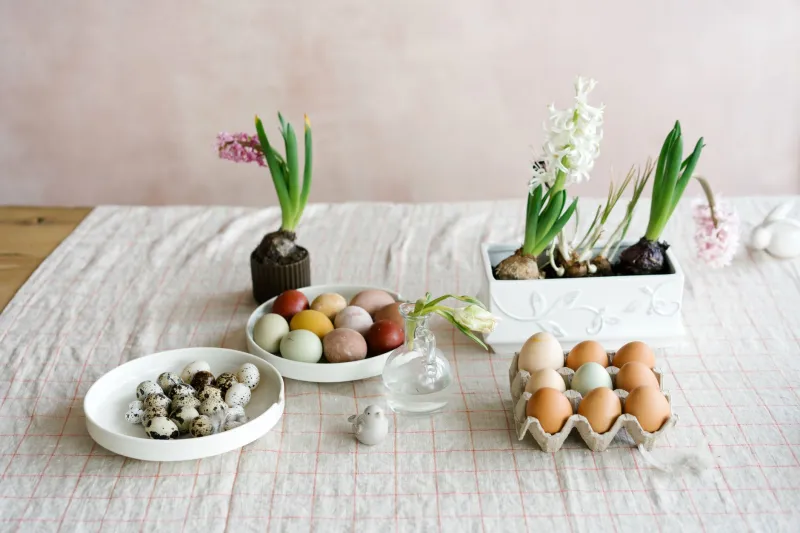
The first is a low bowl of potted bulbs with moss pressed around the base and a few ivy trails allowed to spill over the rim. It is simple, seasonal and almost impossible to make look mean. The second is a tall, loose armature of forced branches and hazel, with bay and rosemary tucked in at the base. Keep the branches bare and let the forced buds do the colour work. The third is a dried-and-evergreen mix: allium heads, honesty, pine and a little moss in a stoneware jug. It is the sort of thing that looks better on the second day than the first.
For entrances and bars, think in gestures rather than volume. A bucket of bare birch, a cluster of bulb pots, a length of ivy along a shelf and a few candles will do more than a dozen mixed bouquets that all say 'we could not get the good stuff'. February styling works when it is allowed to be structural, scented and a little restrained.
The rules for a lean month
Use fewer materials, but use them boldly. Let texture carry the arrangement — bark, moss, evergreen leaves, the papery skin of a hyacinth bulb. Repeat one material rather than scattering five. Keep the colour range narrow: green, cream, soft yellow, a little bronze, maybe a hint of forced pink. And do not overfill. Empty space reads as confidence in February; a crammed vase reads as anxiety.
Event planners should also build the gap into client conversations. Call it late winter rather than early spring. Show a mood board with bulbs and branches instead of blossom and tulips. Offer a plan that can flex if the weather shifts. Clients rarely mind a seasonal brief when it is presented as a deliberate choice rather than a compromise.
The February gap is not the month to prove you can source anything from anywhere. It is the month to prove you can style with what the season actually offers. Brook & Vine's view is simple: there is nothing apologetic about a pot of hyacinths, a branch of forced forsythia and a handful of moss. It is February doing what February does — and doing it rather well.