Mud, Dusk and a Warm Handle: The Winter Entrance That Does the Welcoming
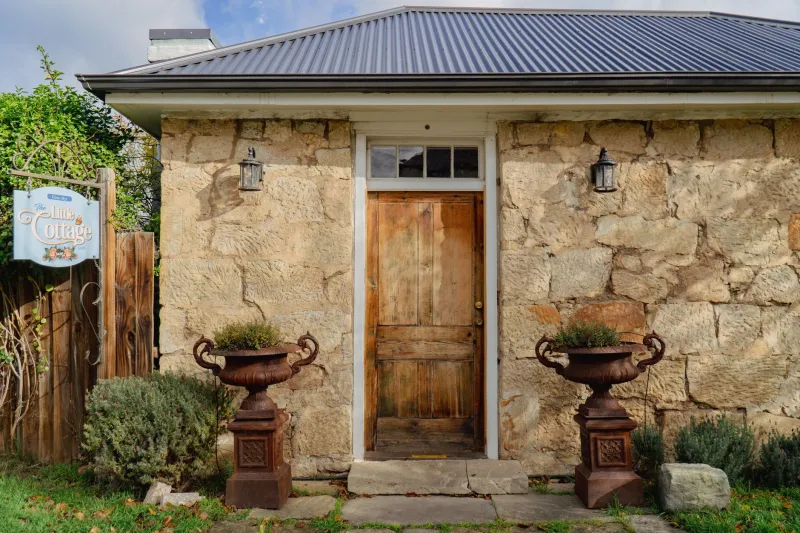
By mid-November, the British threshold has a job on its hands. The light has gone soft and sideways by half past three, the path holds a skin of wet leaves, and every guest arrives carrying a small weather system on their soles. This is not the moment for a perfect arrangement. It is the moment for an entrance that understands what is about to happen to it.
At Brook & Vine, we think of the threshold as the most honest room in the building. It is where hospitality stops being an idea and becomes a handrail, a dry mat, a place to put a wet umbrella. Get those first few feet right and the rest of the styling can relax. Get them wrong and no amount of candlelight further in will quite make up for it.
Start with what arrives on the soles
A winter welcome begins at ground level. Before foliage, before scent, before the first lantern is lit, think about the journey from car to door. Wet grit, leaf mould, farmyard mud and the particular grey slurry of a village-hall car park all need somewhere to go.
A stiff coir mat is the quiet workhorse here, but it needs a home. A shallow galvanised tray filled with gravel makes a practical drip zone and looks purposeful rather than apologetic. Add a boot scraper — cast iron if you can find one, ora simple wooden-bristle brush on a rope — and a lidded basket of cloths for the inevitable. If the entrance is a marquee, use a length of matting over a gravel or bark path so guests are not picking their way across a bog in good shoes. None of this is glamorous. All of it is generous.
Let the foliage take the weather
Winter entrance planting has to survive more than a cold snap. It has to cope with wind funnelling around a porch, rain driving sideways, and the occasional slam of a door. Choose stems that look better for a bit of weathering: yew, holly, ivy, bay, rosemary, birch twigs, dogwood and lichened branches. These hold their shape and their colour when the weather turns.
A pair of bay trees in simple pots either side of a door is almost too easy, but it works because it is legible from a distance in low light. For a village-hall lobby, a broad earthenware pot of rosemary and ivy near the inner door gives scent and softness without demanding attention. In a marquee entrance, weighted planters of evergreen structure will stay put in a gust and signal the way in without looking like a garden transplanted indoors.
Avoid tender stems that collapse after a wet night, and skip anything that needs daily deadheading. The threshold is not a vase. It is a shelter.
Low light is not a problem to solve
The temptation in November is to flood the entrance with light. Resist it. A bright porch can feel like a security lamp; a warm one feels like a welcome. Use low, amber-toned light near the ground — a lantern on the step, a small lamp on a lobby table, a string of warm bulbs under a canopy — and let the dark do some of the work.
Battery lanterns with handles are endlessly useful because they can be moved to wherever the weather is coming from. Place one near the boot tray and one near the guest book, not high overhead. If you are lighting a path, keep the light low and close to the route so it shows the way without turning the garden into a stage.
Put scent at nose height
A wet coat and a cold nose are not looking for a perfume counter. They are looking for something green and clean. Rosemary, bay, thyme and a little cedar or birch bark near the door will do more than a heavy room fragrance. A small bundle tied to a hook inside the porch, or a pot of rosemary on a lobby windowsill, releases scent as people brush past.
Keep it out of the direct rain and away from the floor, where it will simply become wet debris. The threshold scent should be a passing impression, not an announcement.
The three stations of a working entrance
Think of the threshold as three small stations rather than one decorated area. First, the arrival station: scrape, drip, steady yourself. Second, the landing station: a hook for coats, a tray for gloves, a mirror, a place to put a bag down. Third, the departure station: somewhere to check for keys, scarves and the umbrella you came in with.
In a village hall, this might mean a borrowed table with a linen runner, a basket for lost property and a hand-written sign pointing to the loos. In a marquee, it means a clear matted route, a windbreak at the entrance and a staffed cloakroom that is visible from the door. At home, it is a bench, two hooks and a crate for boots. The styling is in the thought, not the spend.
A simple threshold checklist
- Is there a dry, stable surface for wet feet before the first step indoors?
- Can a guest put down a bag, a brolly and a wet coat without asking where?
- Is the path legible at 4pm in November, with low warm light rather than glare?
- Does the planting hold up to wind and rain without daily fussing?
- Is there a green, clean scent near the door rather than underfoot?
- Is there a place for lost gloves, dropped scarves and muddy boots?
- Can one person reset the whole threshold in ten minutes after a wet arrival?
Generosity over fuss
The best winter entrance is not the one that looks most styled in a photograph. It is the one that still works when a guest arrives early, the rain is coming in sideways and someone has brought a dog. If your threshold can cope with drizzle at dusk in mid-November, it will cope with almost anything the season sends.
A warm handle, a dry mat and a clear place to pause: that is the welcome. Everything else is just foliage doing its quiet, weatherproof best.