Look Out First: Styling a Winter Venue Around the View You Already Have
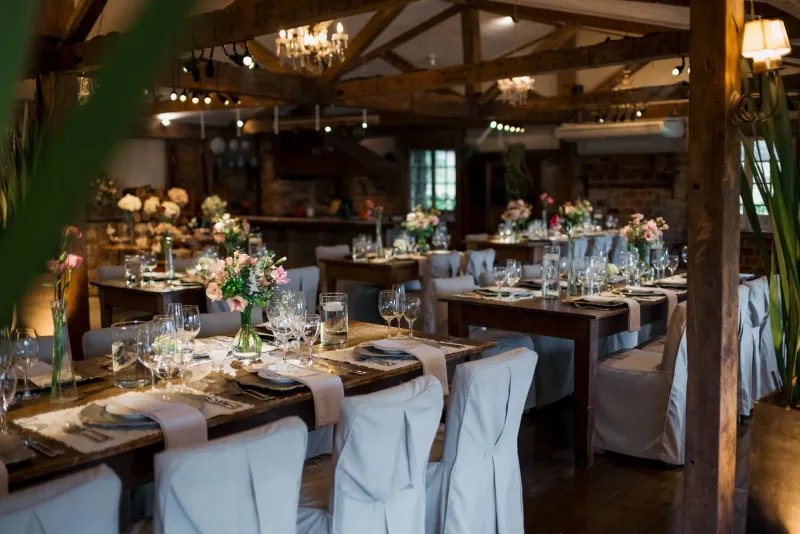
Most winter venue styling starts indoors: table plan, candle count, stem list, then a last-minute glance at the windows. It is understandable. Windows can feel like blank edges to be dressed, or awkward gaps that show the car park. But at this time of year, a room with a view is already half-styled. The trick is to work out what it is looking at before you add anything else.
In a UK winter, that view is rarely a postcard. It might be a damp hedge, a church tower, a bare tree against a pale sky, or a courtyard with one stubborn rose still holding on. Grey skies are not a problem. They act like a large soft reflector, spreading light evenly and making warm colours indoors feel warmer. The view is not the competition. It is the backdrop.
Audit the room from the doorway, not the table plan
Start where your guests will start. Stand in the main entrance, pause, and look. Then walk the room slowly and note where your eye lands. Do this with the lights on and again with them low, because a winter venue changes character after dusk.
Make a simple sketch. Mark the main windows, the doors that open to the outside, any mirrors, and the spots where people naturally gather. Add three labels: best view, useful view, difficult view. The best view is the one worth protecting. The useful view might be a side window with good foliage but poor light. The difficult view could be a fire door, a bin store or a car park. You are not judging the venue. You are reading it.
Ask the venue when the room is at its busiest and quietest. A village hall in the afternoon can feel completely different by 6pm, when the glass turns dark and the room starts reflecting itself. Old barns have deep window reveals that frame a view whether you like it or not. Modern rooms often have long, low windows that suit low tables and floor-level candlelight. The building has already made some decisions for you.
Give the view a job
Once you know what the room is looking at, decide what the view is for. In most cases it will be one of three things: a backdrop, a frame, or a gentle distraction.
A backdrop should stay quiet. Leave the sill clear, keep table arrangements low, and let the outside colour do the work. A frame needs a little help: a curtain left open at the right angle, a branch placed at the edge of the glass, a doorway used as a natural picture frame. A distraction needs more thought. If the view is a service yard, do not pretend it is a garden. Shift seating if you can, use low light, and place a soft edge of evergreen or dried stems where the eye would otherwise go.
This is where borrowed foliage earns its keep. Ask the venue or landowner before cutting anything, take only what is abundant, and use windfall branches where possible. Ivy, bay, rosemary, birch twigs and bare stems can all soften a window edge without blocking the light. The aim is not to hide the view. It is to guide the eye past the awkward bit.
Work with grey, not against it
Grey winter light is forgiving. It flatters warm whites, oatmeal linen, faded terracotta, beeswax candles and dried grasses. It also makes bright, cool colours look harder than they do in summer. If your palette is fighting the sky, the room will feel restless.
Try a simple test. Hold your fabric swatches and stem samples against the window at the time of day your event will start. You will quickly see which colours feel at home and which look like they have arrived from another season. Low candlelight is especially good near glass after dark, because each flame gets a second life as a reflection. Place a few candles where they can echo in the window, but keep the main sightline clear. A row of candles across a view is just a curtain made of wax.
Protect the best sightline
Tables are the usual culprits. We tend to line them up with the architecture, then fill the middle with tall arrangements, and only realise later that the best window is now behind a wall of stems. Walk the room with your table plan in hand and check what each guest will see when they sit down.
If the window is low, keep centrepieces lower still. If the view is tall and narrow, use one upright branch at the end of a table rather than a row of tall vases. Leave a clear corridor to the best window, even if it means fewer tables in that spot. This is not wasted space. It is the room breathing.
Doorways matter too. An open door to a courtyard or garden is a borrowed view in its simplest form. Keep the path clear, check the threshold for trip hazards, and think about what guests will feel when the door opens: cold air, wet leaves, a sudden patch of sky. A winter event can carry a little of that, as long as it is deliberate.
Let reflections join the plan
After dark, windows become mirrors. This can be magical or messy. A dark window will reflect every cable, clipboard and spare chair behind it, so do a walk-through with the room lit as it will be on the night. Move clutter out of the reflection. Check that exterior lights are not glaring back at the glass. If the venue has mirrors, treat them as indoor windows: they can borrow a view from another part of the room, but they can also double a difficult corner.
A useful trick is to place a low arrangement in front of a mirror rather than a tall one. The reflection gives you depth without blocking the room. The same applies to candles: a small cluster reflected in glass feels generous, while a big display can look crowded from the wrong angle.
A simple week-before plan
Visit at the same time of day as the event. Take a notebook, a tape measure and your phone camera. Photograph each main sightline, then look at the photos later rather than trusting memory. Ask the venue about fixings, hooks and anything you cannot move. Test candles and battery lights after dark. Clean the glass if you are allowed to, because winter condensation and fingerprints can undo a beautiful table in minutes.
Keep a small borrowed-view kit: secateurs, twine, a dark cloth for hiding awkward corners, low vessels, spare candle jars and a cloth for wet sills. None of it is glamorous. All of it helps the room look as though it was always meant to be this way.
At Brook & Vine, we keep coming back to the same idea: the best winter styling is not the busiest. It is the most observant. Look out first. Then place the tables, light the candles and let the grey sky, the dark hedge and the quiet window do their share.